Materials: Lightness With a Load Path
Rocket airframes shave grammes because orbital payload fractions demand it, yet even aerospace structures follow one unbreakable rule: never put bending loads into a thin skin meant only for shear, and never join dissimilar materials without accounting for fatigue and corrosion.
Second Moment of Area Beats Brochure Density
In a small workshop, builders often reach prematurely for woven carbon cloth hoping to save weight, only to apply heavy resin puddles that weigh more than thin-walled steel. Bending stiffness scales with the cube of tube diameter (second moment of area, I), meaning a 34.9 mm double-butted 4130 chromoly tube from Reynolds or Columbus (0.8–0.5–0.8 mm wall) resists pedalling torsion superbly while tolerating clamping loads and workshop brazing.
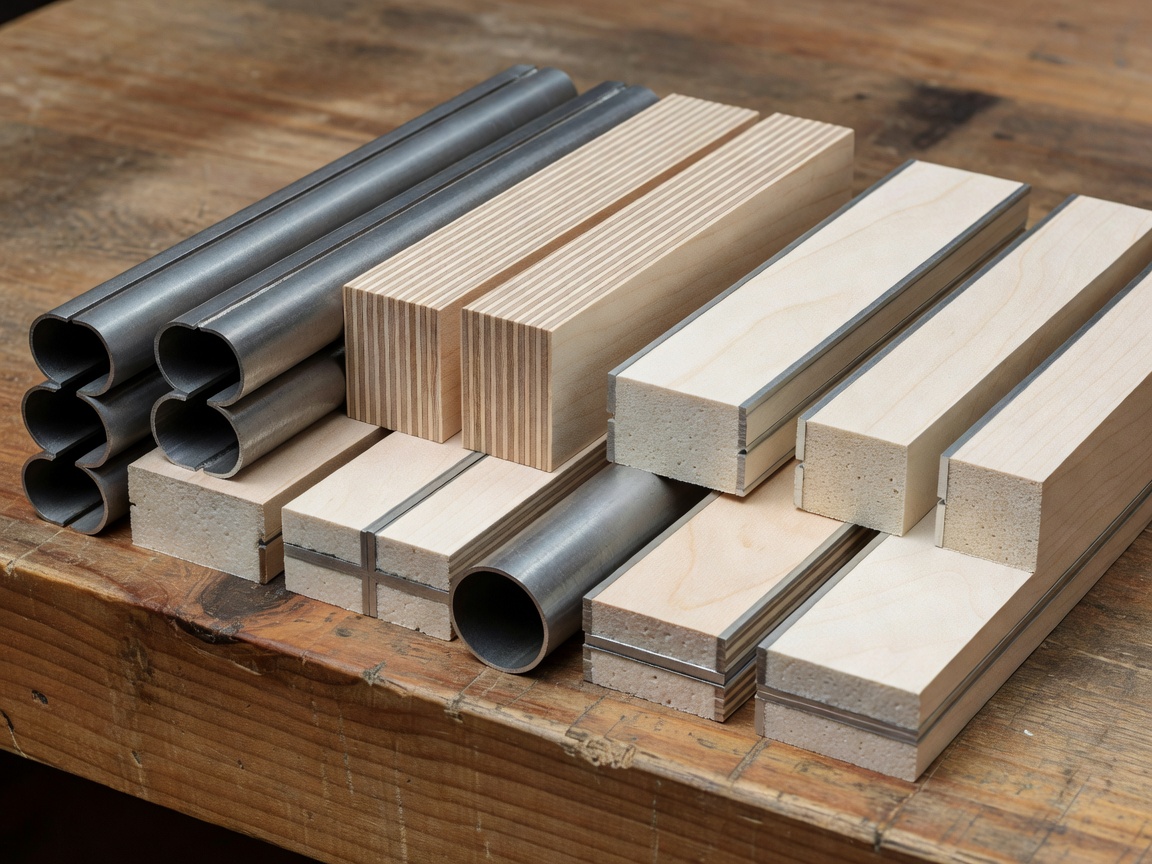
Where aerospace inspiration genuinely shines in home builds is stressed-skin semi-monocoque fairings and sandwich panels. Borrowed from the de Havilland Mosquito and classic sailplane construction, 1.5 mm Finnish birch aircraft plywood or Aramid honeycomb cored skins resist panel buckling across wide fairing curves at a fraction of solid laminate mass.
Replacing a 2.2 mm solid glass-polyester fairing shell with a 1.0 mm glass/foam/glass sandwich laminate cuts fairing shell mass by 42% while doubling panel flex resistance.
300 mm x 300 mm test coupon supported at edges under a 5 kg central brass weight deflected 1.8 mm versus 7.4 mm on the heavier solid single-skin coupon.
Material Properties & Workshop Practicality Matrix
When prototyping without industrial autoclaves or solution heat-treating ovens, how a material responds to ordinary workshop tools—and how visibly it warns you before failing—matters far more than ultimate tensile strength on a laboratory datasheet.
| Material | Young's Modulus (GPa) | Yield / Usable Strength (MPa) | Endurance Limit | Workshop Suitability |
|---|---|---|---|---|
| 4130 Chromoly Steel (Normalized) | 205 | ~460 | True endurance limit below ~50% UTS | Ideal for primary frames, subframes, & brazed brackets |
| 6061-T6 Aluminium Sheet / Tube | 69 | ~240 (drops ~40% if welded without re-aging) | No fatigue floor; accumulates cycles | Best riveted or bonded for fairing skins & struts |
| 3Al-2.5V Titanium | 105 | ~620 | High fatigue & corrosion resistance | Requires argon purge chamber; unforgiving of oxygen contamination |
| UD Carbon / Epoxy (Hand Vacuum Bag) | 110–135 (along fibre) | ~800–1100 (anisotropic) | Excellent in tension; vulnerable to transverse crush | Requires peel ply, vacuum bagging, & glass barrier against alloy |
| Corrugated Polypropylene (Correx) | 1.4 | Non-structural skin only | High flex tolerance; UV degrades over years | Unbeatable rapid prototype skin for aerodynamic tuft trials |
Guarding Against Galvanic Corrosion and Stress Risers
One of the quietest structural hazards in DIY composite-and-metal bicycle builds is galvanic coupling. Carbon fibre conducts electricity along its graphitic filaments and sits near noble metals on the galvanic series, whereas aluminium alloys sit far toward the anodic end. Bonding bare carbon directly onto an aluminium dropout or fairing strut—and then riding through damp winter road grit—turns the joint into a battery that dissolves the aluminium into white powder.
Aerospace and marine builders prevent this effortlessly: always co-cure a single layer of thin 100 g/m² E-glass cloth between carbon laminates and aluminium fittings, maintain a controlled 0.15–0.25 mm adhesive bondline using glass microbead spacers in toughened structural epoxy (such as 3M DP420 or West System G/flex), and taper sleeve ends at 30 degrees to avoid abrupt stiffness jumps.
Structural Inspection & Coin-Tap Routine
- ISO 4210 mindset: Never drill through the tension or compression flanges (top or underside) of down tubes, handlebars, or forks to route wires or bolt nose cones.
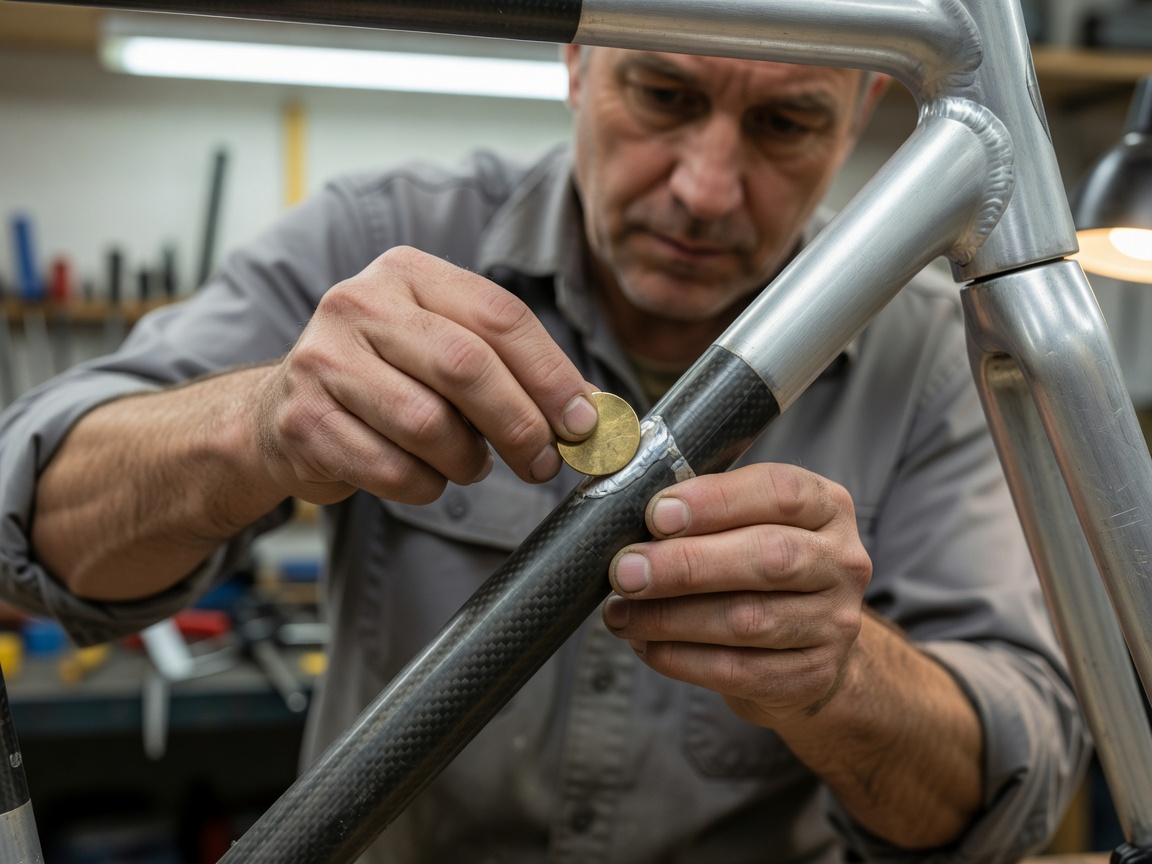
- Acoustic coin-tap test: Tap bonded composite joints monthly with a brass washer; a crisp metallic click indicates solid adhesion, whereas a dull thud signals delamination.
- Dye-penetrant & white-paint checks: Finish high-stress steel braze-ons in light satin paint so hairline coating cracks immediately reveal underlying yield.
- Fastener isolation: Coat stainless steel bolts threading into aluminium bosses with marine lanolin grease or Tef-Gel to prevent galling and electrolytic seizure.